Choose a 1/2-Inch Baseline
For one flooring purchase that covers mixed training, 1/2-inch rubber balances cost, durability, and cushioning. Increase thickness where heavy lifting or dropped bars create greater impact.
Mesa Rubber Flooring recommends choosing home gym rubber by your equipment, the heaviest impact it will receive, and the floor underneath it. Most home gyms in Mesa need rubber between 3/8 inch and 3/4 inch thick, while regular heavy weight drops can call for more protection. The right choice balances everyday comfort, floor protection, and material cost.
For one flooring purchase that covers mixed training, 1/2-inch rubber balances cost, durability, and cushioning. Increase thickness where heavy lifting or dropped bars create greater impact.
A treadmill and a dropped barbell place different demands on rubber. Thin floor protection is not enough for a dropped 45-pound plate; deadlift areas generally call for at least 3/4 inch.
Identify whether the rubber will cover poured concrete, OSB, or existing tile. The surface affects adhesive selection and moisture-barrier needs, while framed floors over joists require different cushioning considerations from a garage slab.
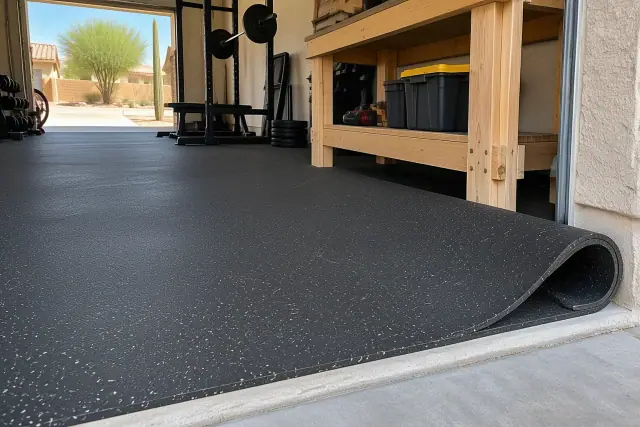
Rolled rubber creates fewer seams across a garage gym floor. A continuous finish is useful when the room also serves as parking or flexible household space.
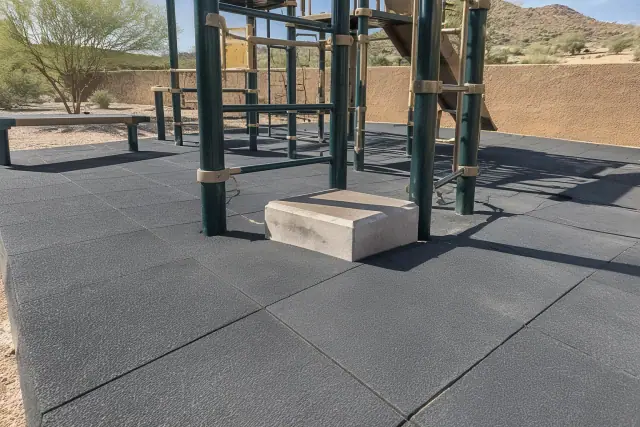
Thicker interlocking tiles concentrate cushioning where barbell work happens. Individual tiles are also easier to replace if one part of the training zone is damaged.
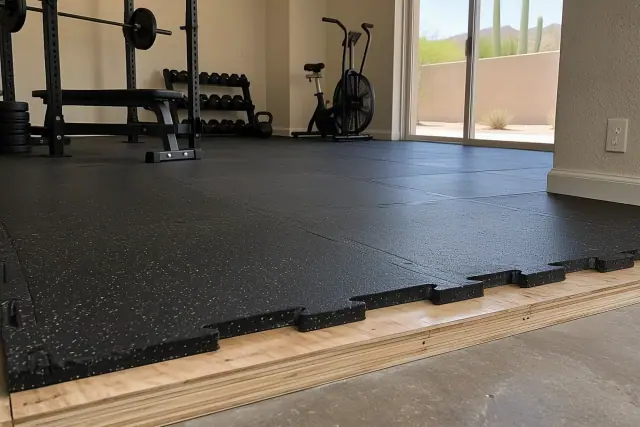
A platform with 3/4-inch rubber over two layers of plywood is an option for regular heavy deadlifts. It combines the rubber surface with a dedicated lifting area instead of relying on thin room-wide flooring.
1/4-inch rubber can protect the floor under a stationary bike or elliptical. Treat it as surface protection for low-impact equipment, not cushioning for dropped weights.
For a room with a rack, dumbbells, and cardio machines, 1/2-inch rolled rubber at roughly $6 to $7 per square foot balances coverage and cushioning.
If you regularly drop more than 135 pounds, consider 1-inch rubber or a dedicated platform. Choose for the heaviest impact the floor will see, not just the average workout.
A 3/4-inch stall mat costs around $55 per 4x6 mat. Its weight and the difficulty of cutting around posts or drains can complicate installation, and unsecured mats may shift.
| Home Gym Use | Rubber Thickness | How to Apply It |
|---|---|---|
| Stationary bike or elliptical | 1/4 inch | Surface protection under low-impact machines; unsuitable for dropped weights. |
| Yoga, bodyweight work, and light dumbbells | 3/8 inch | Use for light training without barbell drops. |
| Mixed cardio and strength training | 1/2 inch | Baseline for general room coverage; add thicker rubber in impact zones. |
| Deadlifts and a dedicated weight area | 3/4 inch minimum | Match coverage to the full lifting zone and check the subfloor. |
| Regular heavy drops over 135 pounds | 1 inch or a dedicated platform | Assess a platform or layered construction for repeated heavy impacts. |
Rolled rubber and interlocking tiles between 1/2 inch and 3/4 inch are practical options for home gym coverage. Rolls offer fewer seams and a more finished appearance; tiles install faster and allow damaged sections to be replaced individually. Rolled rubber typically costs $4 to $8 per square foot depending on thickness, with 1/4-inch material near $4.17 and 1/2-inch material closer to $7.50 per square foot. Installation adds cost for subfloor preparation, seaming, and adhesive work. Compare material, preparation, and labor separately in an itemized estimate, and consider using thicker rubber only in the lifting zone.
Mesa garage slabs can regularly exceed 120 degrees Fahrenheit in summer, affecting rubber expansion, off-gassing, and its bond to concrete. Allowing rolled rubber to acclimate on-site for 24 to 48 hours before laying it helps reduce buckling as the space heats up. Concrete slab garages generally need less cushioning than framed floors over joists, but heavy lifting still calls for additional impact protection. Climate-controlled basement gyms usually have less thermal movement: 1/2 inch generally suits mixed use, while heavy barbell work still calls for 3/4 inch. Confirm the subfloor, moisture conditions, and adhesive requirements before installation.
Is 8mm rubber enough for a home gym? At roughly 5/16 inch, it suits machines, bodyweight exercise, and light strength training. For heavier lifting, consider thicker options such as 12mm or 1/2-inch rubber, with more protection wherever bars are dropped. Will 3/8 inch still work if I add a squat rack? It is undersized for barbell work, so include planned strength equipment when choosing the floor. Do home gyms need commercial flooring thickness? Commercial zones typically range from 3/8 inch to 3/4 inch, but traffic tolerance and durability also matter. Choose residential flooring for your actual training and impact levels rather than the commercial label alone.
For a home gym in Mesa or the East Valley, share your equipment list, subfloor type, and whether your training includes dropped weights. Request an itemized estimate covering rubber thickness, any separate lifting zone, surface preparation, and installation labor.