Moisture Trapped Beneath the Mat
Rubber resists mold, but it also limits evaporation from the slab beneath it. Dust or other organic residue in that damp space can support growth even when the upper surface appears clean.
At Mesa Rubber Flooring, we find that mold can grow beneath rubber flooring when moisture stays trapped against the subfloor. The rubber itself does not feed mold, but hidden dampness and accumulated dust can support growth. That distinction matters in Mesa garages, home gyms, and commercial spaces exposed to condensation, cleaning water, or monsoon moisture.
Rubber resists mold, but it also limits evaporation from the slab beneath it. Dust or other organic residue in that damp space can support growth even when the upper surface appears clean.
Indoor humidity above roughly 60 percent increases mold risk beneath impermeable flooring. Enclosed gym spaces and garages need particular attention when humid air meets a cooler concrete slab.
A professional inspection can check beneath affected sections and assess the concrete for moisture. The findings help separate water-entry problems from condensation or slab vapor before flooring is reinstalled.
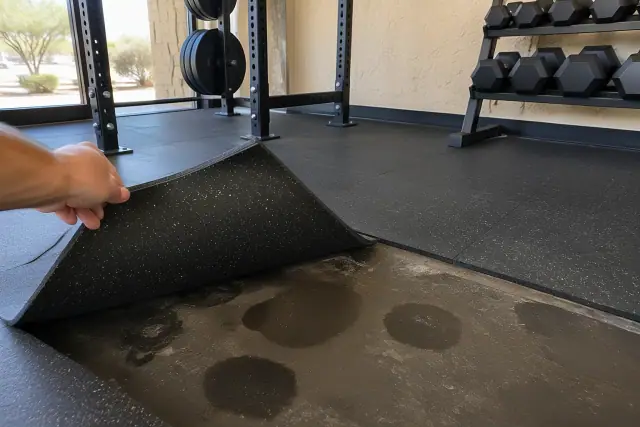
Dark green, black, or grayish spots may appear on the underside near damp seams or edges. Their color alone does not identify the mold species.
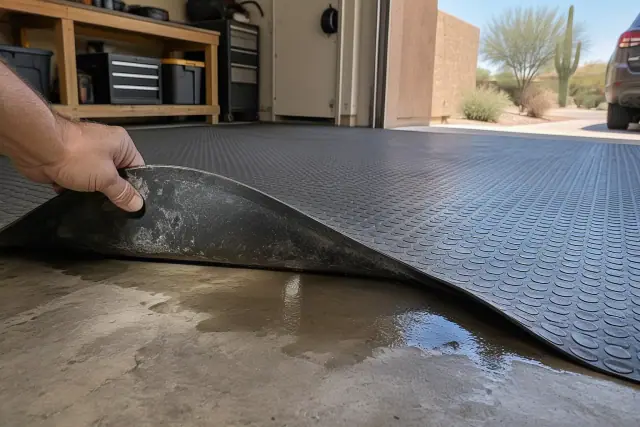
A flat-bottomed mat can hold tracked-in runoff or condensation against concrete. Drainage channels and a suitable path for water to escape matter in wet-prone garages.
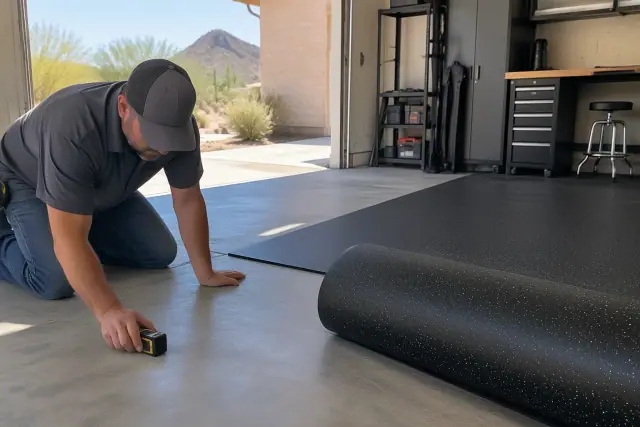
In-situ probes assess moisture within the concrete before rubber covers the slab. Readings need to meet the flooring manufacturer's tolerance before installation proceeds.
Sweat and mopping water can enter seams in home or commercial gym flooring. Give the floor adequate drying time after cleaning, and check tile seams periodically where moisture exposure is frequent.
Slabs poured within the last two years, or slabs without an underlying vapor retarder, deserve particular attention to moisture vapor emission. A surface that looks dry still needs testing before it is covered.
Check especially after humid spells from July through September. A smell that returns after surface cleaning, bubbling rubber, or edges losing their grip calls for inspection of the mat and slab.
Avoid wall-to-wall glue-down flooring over unsealed concrete without addressing moisture first. Surface antimicrobial treatments cannot correct water collecting underneath, and installing fresh rubber over a damp slab leaves the cause unresolved.
A symptom identifies an inspection priority; it does not by itself confirm mold.
| Clue beneath or around the rubber | Moisture source to investigate | Practical next action |
|---|---|---|
| Damp concrete beneath a mat | Vapor emission through an unsealed or unprotected slab | Test slab moisture and select compatible sealing or vapor protection before installation. |
| Water near gym tile seams | Sweat, spills, or cleaning water entering between tiles | Allow adequate drying time and inspect seams and the area beneath affected tiles. |
| Moisture on a cool garage slab | Condensation from warm, humid air | Assess ventilation and humidity control, along with drainage beneath wet-prone mats. |
| Musty odor that returns after cleaning | Concealed dampness or possible growth beneath the flooring | Arrange an underside and slab inspection instead of relying on another surface cleaning. |
| Curled edges, bubbling, or failed adhesive | Water damage and moisture collecting beneath loosened flooring | Assess the affected floor and correct the moisture source before repair or reinstallation. |
Mold can develop after 24 to 48 hours of sustained dampness, so rubber's resistance to decay does not make the space beneath it mold-proof. Moisture reaches that space through vapor rising from concrete, water entering seams, or condensation where warm, humid air meets a cool slab. Dust and other organic residue can supply material for growth. Moisture testing helps assess the conditions; it does not identify a mold species. When growth is found, cleanup needs to reach the affected underside and slab, with the moisture source corrected and the floor allowed to dry before reinstallation.
Mesa's indoor-outdoor temperature swings can reach 30 degrees or more between summer afternoons and evening cooldowns, making condensation a concern where warm, humid air meets cooler concrete. Below-grade basement gyms also need groundwater and waterproofing conditions assessed; industrial wash-down areas need planned drainage. Rolled rubber has fewer seams than interlocking tiles, but both depend on subfloor preparation. We follow ASTM F710 guidance for concrete preparation and moisture testing, then check readings against the flooring manufacturer's limits. For rolled rubber and tile installations, we use a 6-mil or thicker poly vapor barrier as our minimum specification, with moisture protection suited to the slab and installation method.
Will cleaning the top remove mold underneath? No. Cleanup has to reach the affected underside and slab, followed by drying and correction of the moisture source. Is any surface automatically mold-proof? Smooth, dry, clean surfaces such as glass, stainless steel, and sealed concrete resist growth, but moisture and organic residue change the conditions. How often should loose mats be checked? In high-moisture rooms, lift and clean beneath removable mats every few months, and investigate sooner if mustiness or water damage appears.
Describe the room, when the odor or dampness started, and any visible edge or seam damage. Our team works with garages, home gyms, and commercial flooring across the East Valley and can help assess the moisture problem before repair or reinstallation.